Sunday, October 31, 2010

Naha: Please Stand Clear of the Closing Doors


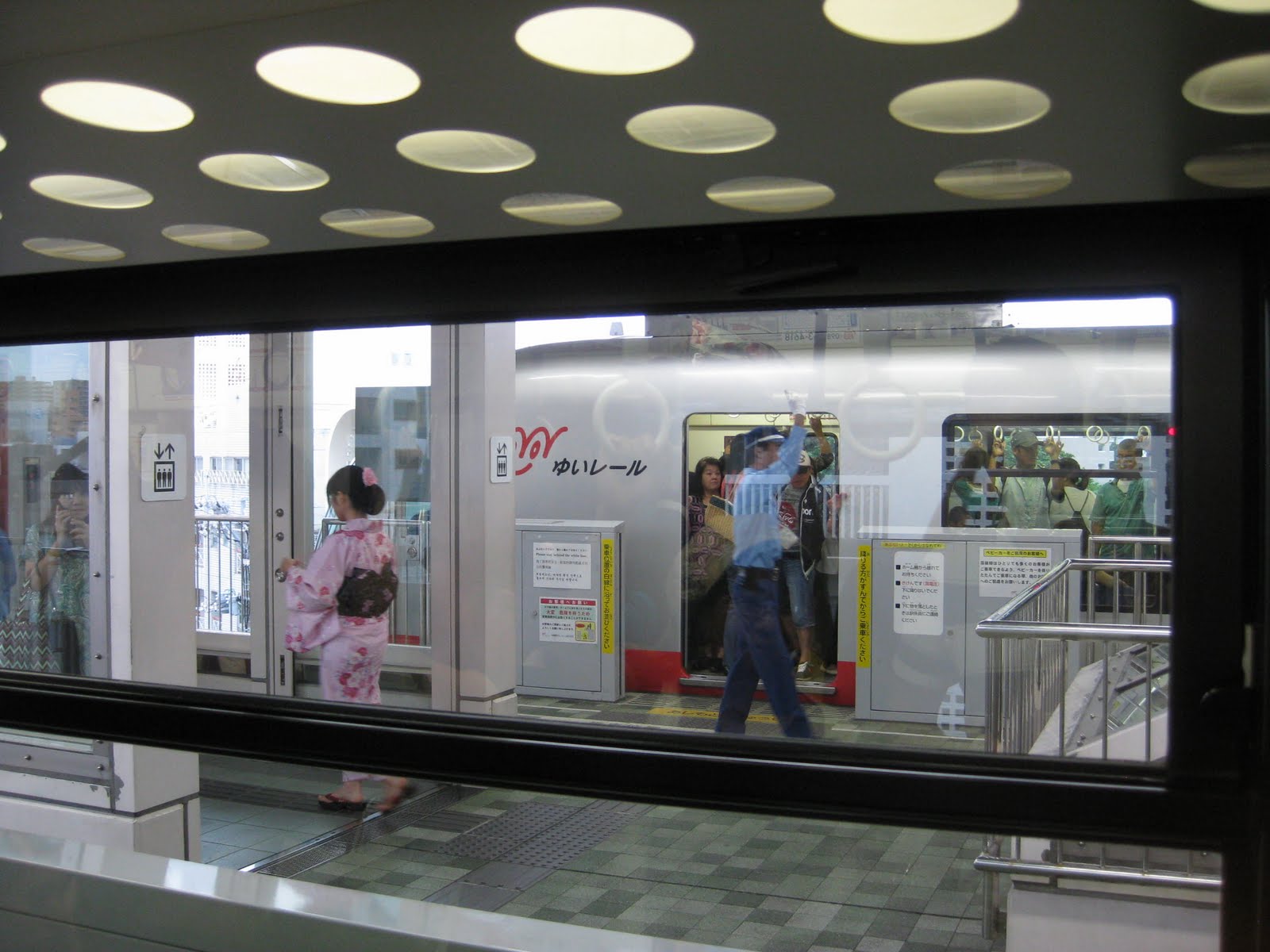
The only train on the island of Okinawa is a monorail. It is located in the city of Naha. With population of about 300,000, Naha is Okinawa's largest city.
I loved the automated fare machine. Like buying a ticked on the Tokyo subway system, you look for your destination and its fare on the map posted on the wall above the fare machine. Simple enough. But, the coin jammed in the fare box while Gordon was trying to buy our monorail tickets. While Gordon was momentarily staring at the fare box to try to figure out how to get our change back, a man's head and arm emerged from between two fare boxes. The man reached around, jiggled the machine and delivered the tickets.
Also like the Tokyo subways, the monorail stations have uniformed attendants wearing white gloves, to "guide" passengers onto the train cars.
And my favorite part was the little stickers on the train doors inside the cars, with graphic pictures of crabs with pinched claws, to keep your hands away from the closing doors.

Talking Trash in Tokyo


Taking out the trash in Tokyo is a complicated affair. The trash room in Gordon's apartment building has twelve different categories of trash. Not only is the recycling separated into multiple categories, but the rules go so far as to require that the plastic recyclable bottles must also be separated from their caps. The trash bins are numbered. Different categories of trash are collected on different days. Instructions on how to sort and dispose of trash are illustrated, color-coded, published, and posted on the trash room wall. And, the trash room is spotless.

Okinawa Peace Park has 1000 Cranes and Underground Caves


Monument with American Soldiers' Names Carved Into It


Paper Cranes Made by School Children
Underground Caves Where Native Okinawans Hid from the Japanese and Americans During World War II
Reading Room Displaying Testimonial Stories of Survivors Who Described Their Experiences 

The Peace Park at the southernmost tip of Okinawa island is a lovely seaside park, but a grim reminder of World War II. The memorial museum is perched on a spectacular spit of land overlooking the South China Sea. A low-walled stone monument bearing American names carved into its sides, snakes through a shaded park, evoking a very strong similarity to the Vietnam memorial in Washington, DC.
A short stroll away is a beautiful sculpture garden with different monuments, each representing a prefecture of Japan. One monument looks like a soaring torch, cradling a globe in its center. Another shelters 1,000 colorful origami paper cranes. The cranes follow an ancient Japanese legend that promises that anyone who folds 1,000 cranes will be granted a wish. Cranes are revered by Japanese as special creatures who are said to live for 1,000 years. School children folded the cranes for the memorial.
If you ask, the entrances to the underground caves will be pointed out. Although the entrances are covered with bars now, it is possible to visit some of the spots where the Okinawan natives hid and lived for months while the Japanese and then the Americans invaded their island home. The Okinawans lived in underground caves for months, fearing violent death from the soldiers who battled on their island. As portions of the island were conquered, Okinawans fled thier homes, migrated and congregated in the south, eventually retreating to live in the hills. They were led to believe that if they were discovered or captured by Japanese, or later by Americans, they would be tortured and killed. As the armies approached, many preferred to control their own destiny by running to the ocean-edge cliffs and killing themselves by jumping into the sea. Over 200,000 Okinawans died in the World War II battles on their island.
A beautiful simple room in the Peace Memorial Museum has Testimonies from survivors on display to read. Some of the transcripts are translated into English. The stories are gory, heartbreaking and riveting.

Scary Venomous Life in Okinawa

The Seemingly Innocuous Blue Float Boundary in the South China Sea at Moon Beach Palace
Bad Things That Can Happen if you Get Bitten


The Deadly Habu Snake
What Those Puffy Plastic Blue Floats are REALLY For - - Stinger Resistant Enclosures

A visit to Okinawa will provide cautious (as well as neurotic) travelers good reason to be nervous about nature's threats. We stayed at Moon Beach Palace, a safe-enough looking place with a lovely beach resort on the South China Sea, with soft sand, chaise lounges separated by beach umbrellas, and a waterfront fully stocked with kayaks, jet skis and big boats for skippered outings.
The swimming area is outlined by rope punctuated by blue foam floats. The scariness evolves when you approach the water's edge and read the signs. Fortunately, the signs are in both Japanese and English so that English-speaking tourists can take in the gravity of the warnings. The Notice starts predictably enough, with routine reminders like: Children Must be Accompanied by an Adult, Do Not Swim When the Flag is Red, and No Pets. Then, it was endearing to read the awkwardly translated manners-controller, "Prohibit Any Conducts That May Embarrass Others". But finally, the safety warning was simply, "Swim Only in the Authorized Areas". Upon closer inspection, what had appeared to be an ordinary roped-in area was actually a protective net. The rope on the water's surface was actually the top of an enclosure-like cage formed from soft netting, anchored around the perimeter of the safe-swim area.
The reason for the protective cage became evident when we read the next sign, "Venomous Marine Life in Okinawa". There were detailed instructions what to do when bitten or attacked by various nefarious sea creatures. The instructions were hilarious -- unless, of course, you actually needed to heed them. Photos of the offending creatures accompanied the first-aid steps. For an injury by one creature, you must use vinegar. For a different one, no matter what you do, don't use vinegar. Seek medical attention at once. Use cold water and ice. Whatever you do, don't use ice; use heat. (Right!) My takeaway was to seek medical attention for everything, disregarding all of the detailed directions, since you probably wouldn't know how to match what bit you with the pictures of what to do about it.
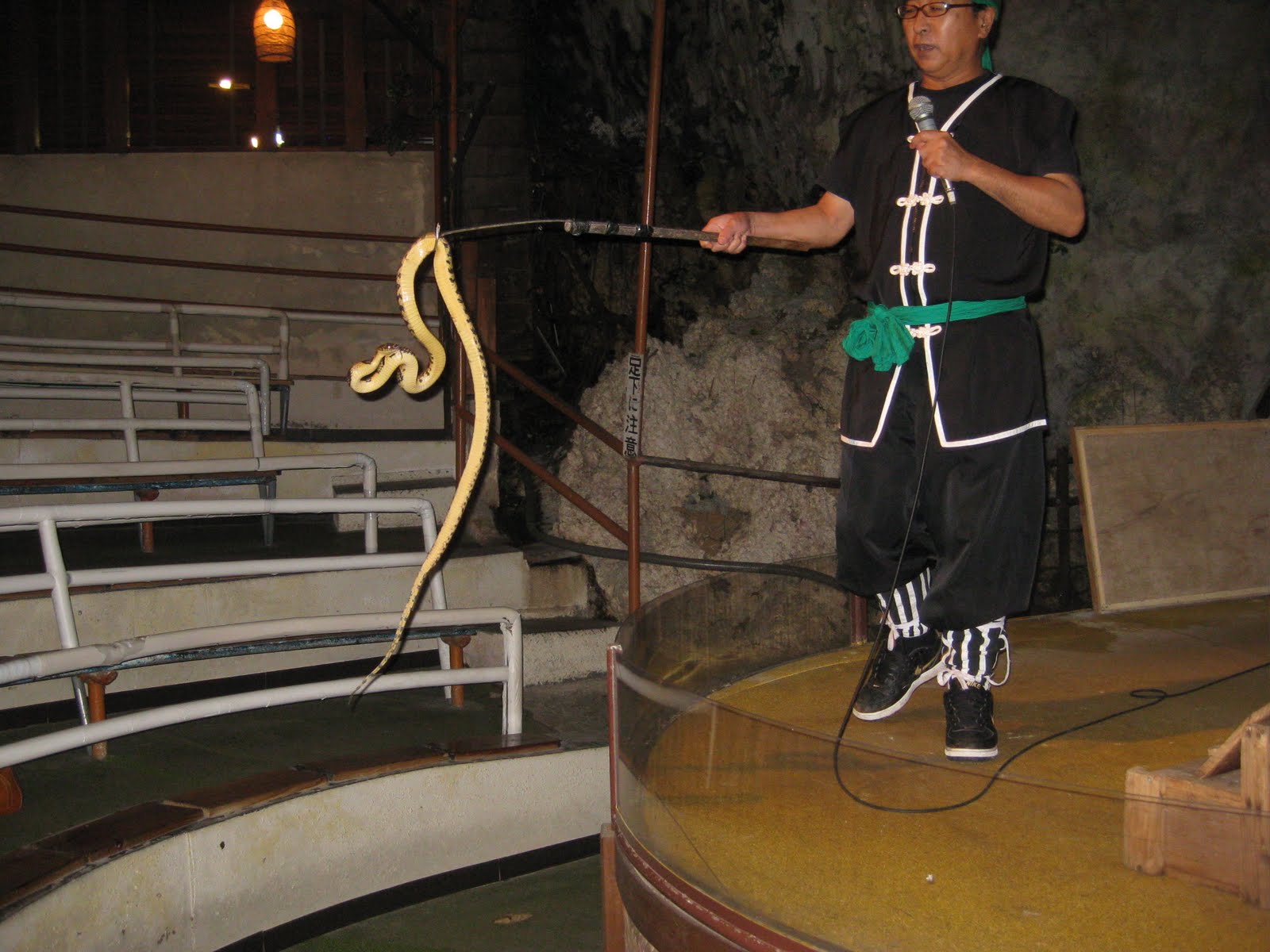
We decided to get away from the potential terrors of the beach. (Not really -- we had our fill of swimming and were ready to go out touring). We visited the cultural center at Ryuku Mura, where we encountered the deadly habu snake. The habu is a venomous pit viper snake unique to the Ryuku archipelago, of which Okinawa is the largest island. To visit the habu snake theater, we had to pay an upcharge beyond the general admission fee to the cultural center. As we entered the theater, we passed by photographs on the wall showed disgusting injuries from habu bites, which are often fatal. A demonstrator pulled a habu out of a box, placed it on a stick, and waved it across the front row, where I was sitting. A little too close for my comfort. But I did snap a picture. The habu show ended with a silly 3D video of a habu encountering and succumbing to its natural enemy - the mongoose, which was imported from India about 100 years ago. The video was anamatronics of the hokiest kind, where the mongoose and the snake joust and parry in jerky motion until the mongoose strikes and crushes the snake. Upon leaving the theater, we passed by a sign of apology. "Notice: Habu and Mongoose fight show has been forbade by the law of animal protecting. Now, we introduce and present the show on 3D screen with explanation in Japanese. Thank you very much for your understanding". It was OK with me not to see that gory fight in real life.

Friday, October 15, 2010

Jokan Ji - Honoring Death by Fire

Remembering the Dead

Memorial Tombs, Black Cat Sitting on Top

In the northern part of Tokyo, near Ueno (say "Way No") is a small Buddhist temple called Jokan Ji. It is hard to find, tucked on a side street. The temple's building is surrounded by scaffolding and is undergoing renovation. We took a peek into the temple office and saw a robed monk painting calligraphy with a paintbrush, surrounded by piles of papers and books in a musty cluttered room. The main attraction at the temple is the cemetery and its history. Around the time of the 1650s, Tokyo was known as Edo. The area surrounding the temple was overcrowded with brothels made of straw and paper. Buried in the cemetery are people who died in the frequent fires, one wave of which killed a reported 100,000 people. The temple cemetery also memorializes the courtesans who were tossed over the temple wall, rolled in straw mats after outliving their usefulness, whether they were dead or alive. (The "or alive" part of the story was published in Lonely Planet Guide for Tokyo, but I didn't see that part of the story mentioned in anything else I read). A black cat posed on top of one of the memorials just as I snapped a picture.

Behind the Barbed Wire at Kadena Air Force Base on Okinawa

One of the Hangers That Kamikaze Pilots Used in World War II
The "BX", or Base Exchange
Suburban-esque Housing
Golf Course on Base
We toured the US Air Force Base at Kadena, as the guests of a gracious host who is stationed on the base. We were grateful for the opportunity to see what's behind that miles-long barbed wire covered fence that cordons off a chunk of the island of Okinawa. The base is "closed", which meant for us that civilians can enter only if signed in by someone stationed on the base. We made arrangements to meet our host at 11:00 for him to drive us around on a tour, and ending up meeting his family for lunch at the Tea House. Mistakenly, I thought he said the Tea House. He actually said the "Tee" House, which is the restaurant perched at the top of a steep hill with a magnificent view of the driving range, golf course and ocean. And, the view also takes in the landing strip where pilots were circling around repeatedly landing and taking off, to achieve the required number of landings and take-offs to maintain their proficiency.
We thought the base was huge. Apparently not by military standards; but we had little to compare it to. The houses look like a suburban subdivision that goes on for miles and miles; and could be a TV set or a dated version of The Truman Show. We drove by just one of the three full-blown elementary schools.
The base appears to be completely self sufficient to support the people who live there, with barbershops, veterinary hospital, car repair shop and so on.
The "BX" as the shopping mall is called, could outclass most shopping centers. "BX" stands for Base Exchange - the corollary of PX, or Post Exchange at an Army Post. The thing is absolutely huge, with a food court filled with Taco Bell, Burger King, Popeye's and so on. The stores look like a giant Walmart - brightly lit, wide, tidy aisles of endless types of merchandise from Yankee Candles to Coach handbags. They even sell cars and Harley Davidsons.
Okinawa's military base provides support for operations halfway around the world from much of the USA. It was an important facility for the Vietnam war. The US government took it from the Japanese at the end of World War II, when it had served as a Japanese military base. There are hangers still remaining that were built into the sides of hills, where the Kamikaze pilots took off for their missions at the end of World War II.
Local farmers are allowed onto the base to cultivate plants on some of the unused plots of land. Kind of like community gardens??

Shisa Always Come in Pairs


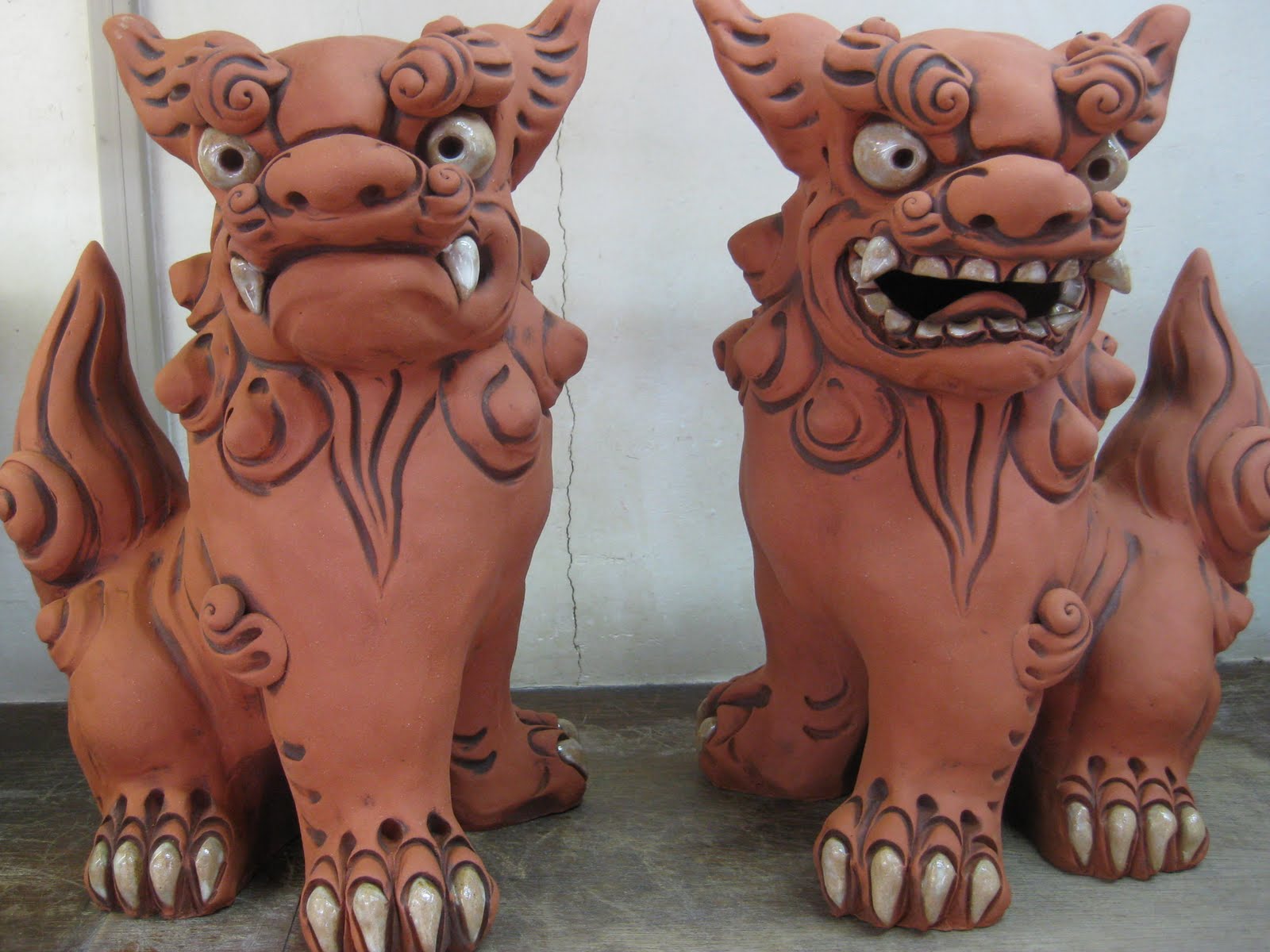
All over Okinawa we saw statues of dogs that are kind of square looking with curly fur. They often flank the doorways of homes and businesses, and sometimes are even seen perched on rooftops. They are called Shisas and they are typical to Okinawa. Shisa come from Okinawan mythology and are a cross between a dog and a lion. They look like the Chinese guardian lions, but appear friendlier. We learned that the one on the right always has his mouth open and the one on the left has his mouth closed. There are differing explanations. The mouth-open sound is like the first letter of the Japanese alphabet which sounded to my very untrained ear like "aaahhh" and the last letter sounded to the same unsophisticated ear like "mmmm". The open-mouthed shisa takes it all in, evil spirits and all. The closed-mouth shisa shuts it out. Another explanation (which is somewhat contradictory) is that the open-mouthed shisa scares away the bad and the closed-mouth shisa keeps in the good.