Saturday, October 17, 2015

Fish are Jumpin' at Viccuria Market, Palermo


I went fish-shopping at the Viccuria in Palermo. It is an outdoor food market -- one of several in Palermo, but this one is the oldest.  The fresh fish are right out of the Tyrrhenian Sea. The thing that struck me was that they are displayed like they are jumping off the counter. The heads are tied to the tails, putting them in a curvy pose, as if they are swimming in formation.

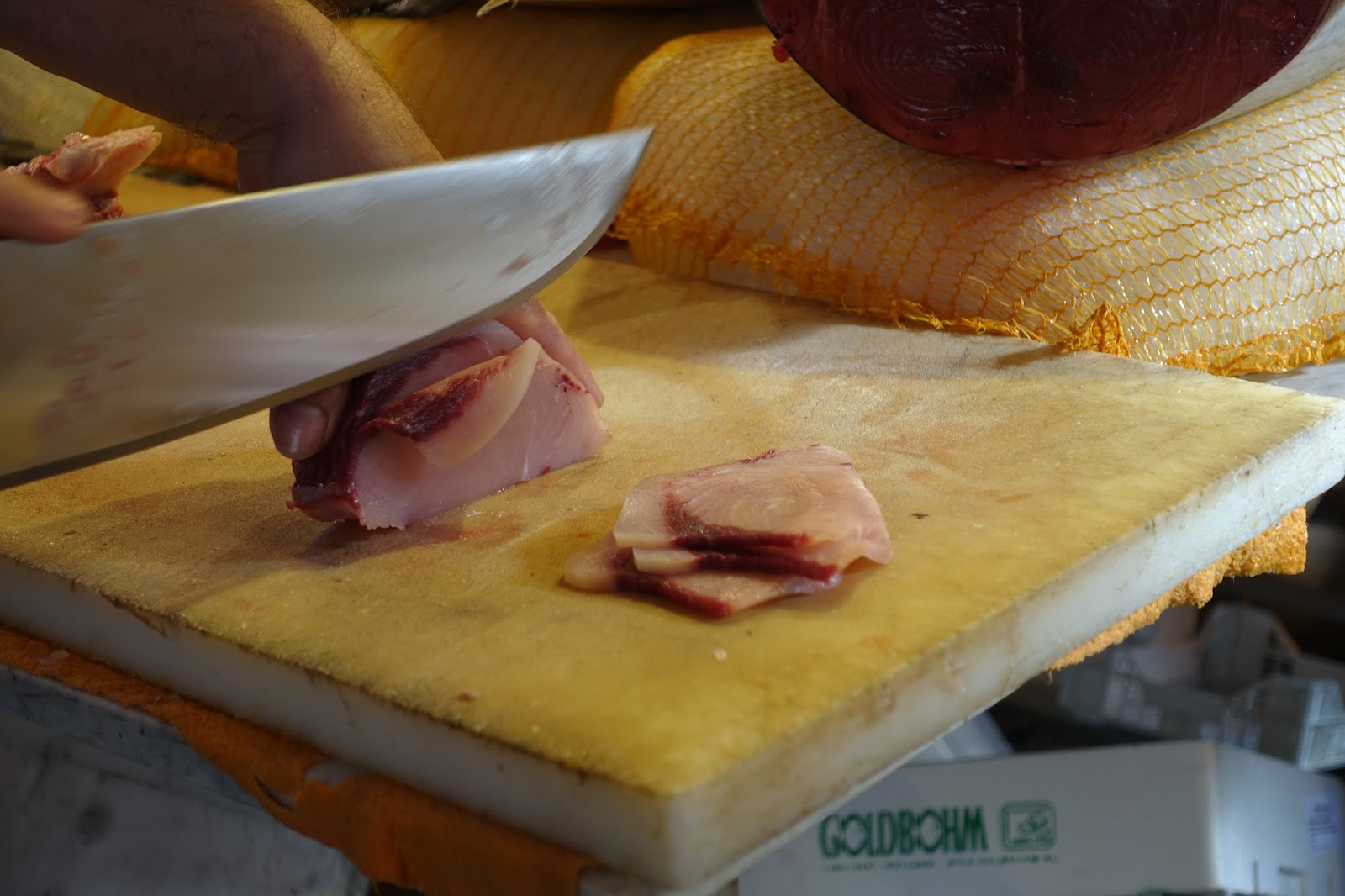
I was shopping in the market to procure the ingredients for a cooking class with a Duchess....more on that in a separate post. The Duchess is really picky about her vendors. First stop was for fish. She uses only this place. She had the fish monger slice the swordfish into very thin slivers, to use for rolling into Involtini di Pesce Spada (swordfish rolls).
The Duchess's Fishmonger at Viccuria Market, Palermo
Slicing Swordfish into thin Slivers
Involtini di Pesce Spada (swordfish rolls) ready for cooking


Bring on the Lardo

Lardo - All in its naked glory, Fat, Fat, Fat

While on a fabulous food trip through the Piedmont region of Italy, the pressure was on to taste the lardo. Linda Plazonja, who runs Morso Soggiorno, led this wonderful trip of off-the-beaten path artisanal food experiences. She insisted that I taste the lardo, assuring me that I would be glad I did. Lardo was not my first go-to item to choose from among beautiful meats, cheeses, olives and caponatas. Not being a big meat-eater, I was happy to eat the salami. It was heavenly. But Lardo?? A glistening wad of naked fat?  Well, I'm so glad I passed that slithery slab over my lips. Oh my!! I am now a lardo fan. It was delicious. Having read up on it, I now know that Lardo is not the same thing as Lard. Lard is a cooking fat, used like butter. Lardo (emphasis on the "OH!"), is a type of salumi, or charcuterie, sliced very thinly, and deserves its place on the antipasto plate. It is made by curing strips of fatback with rosemary and other herbs and spices.

Lardo sits on top of salami. It's almost like it's saying "Pick Me! Pick Me!", at Tra Arte e Quercia in Monchiero
Cheese and condiment sampler served with wine tasting at Cascina Val del Prete - different place, different story. Just showing this in contrast to the fat slabs of lardo


Friday, October 16, 2015

Truffle Hunting: It's all about the Dog, About the Dog

I always thought that without wild boar, the world would be truffleless.  Wrong. While the French rely on crazed pigs to find their precious truffles, the northern Italians use dogs. Really smart, really focused, well trained dogs.

I had the fantastic opportunity to go truffle hunting with Etzio and his dog Dora, in the Piedmont region of Italy. The trip was part of a terrific food-focused trip organized by Morso Soggiorno out of Boston. Etzio owns a large property where he hunts and occasionally lets visitors follow along with him. The property is located near Alba, and is about 35 miles southeast of Turino (known as Turin in English).
Etzio's land is covered with groves of trees, some maple, some oak and another whose name I didn't catch, even though it was translated into English. The truffles are like mushrooms, in that they are a fungus. But unlike mushrooms, the truffles are found about 6 inches underground, at the base of a tree, amid the roots, and within only a few feet of the tree's trunk. Truffles are an extraordinarily precious commodity. They are harvested for only a short period and because of the worldwide demand for them, a truffle broker waits nearby to purchase Etzio's findings. The white truffles are more valuable than the black ones; with white Alba truffles retailing at about $40 per ounce.

Etzio trained Dora to seek the scent of truffle around the tree bases. When she finds the smell, she begins to paw at the ground furiously. She would love to eat the truffle. Not happening. When Etzio sees that Dora has scored, he pets her enthusiastically, grabs her collar, pulls her away from the spot and bribes her with treats, usually pitching them far away as a diversion.

The first truffle we came upon was black. Its earthy aroma was more intense than any truffle or truffle oil I ever encountered. But, that was NOTHING compared to the perfect emanations from the white truffle. It's easy to understand in one sniff why the white is so much more precious than black.
Etzio carefully uses a tool much like an archeologist would, to unearth the impacted prize.

After about an hour of hunting, Etzio and Dora yielded 4 truffles, a mix of black and white. A broker weighed them, with two whites coming in at 65 grams.

Then, in the family-style trattoria near Etzio's hunting grounds, we experienced possibly the dreamiest pasta I ever ate. Shaved white truffles sprinkled over freshly homemade pasta.

Dazzling Golden Mosaics in Palermo Sicily's Monreale Cathedral

The Cathedral of Monreale is just 10 miles from the center of Palermo (20 minutes if the traffic is light - which apparently it rarely is). The church is one of the main attractions in Sicily, and all of Italy, too. It was built outside of Palermo during the time when the Arabs occupied Palermo, when the Catholic Bishop moved out. After the Normans drove out the Arabs in 1072, the Catholic Bishop moved back into Palermo. But this souvenir of the exile is a magnificent display of Arab influence through the use of Byzantine tiles. The brilliantly colored glass mosaics laid on a gold background cover the entire surface of the upper walls. The tiles are tiny and intricate, yielding art that looks like painting. The images tell the Bible stories to the probably mostly illiterate church-goers who have worshipped here since its dedication in 1182. This church is the largest display of Byzantine mosaics in Italy.

I am not exactly a Biblical scholar, so I was limited in my ability to pick out the bible stories from the pictures on the walls.
Depiction of the story of Noah's Ark (obviously)
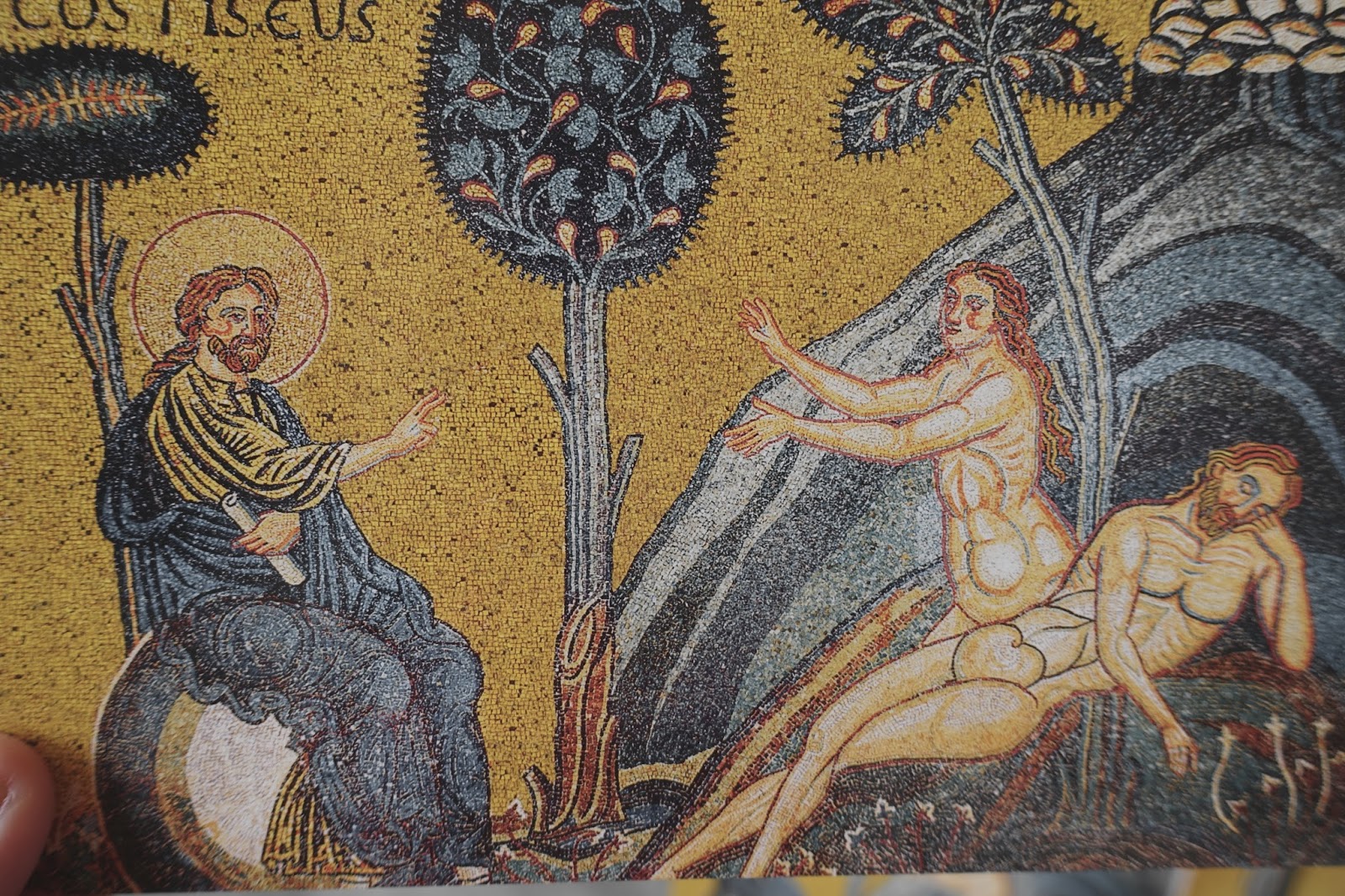
Eve emerging from Adam's rib
The Adam/Eve story was tucked in the farthest corner of the top ceiling of the back of the church. A fellow traveler spotted it. Being virtually impossible to grab a decent photo because of the low light and the weird contortions needed to get the right angle, I resorted to the next best thing. I took a photo of a postcard in the gift shop outside the church.
Postcards in the gift shop - took a pic of the pic

Wednesday, September 2, 2015

The Tourists are Streaming

The stream of people walking on Newport's Cliff Walk thickens in the summer. As a regular cliff walker myself, my routine is a 4 mile round trip midsection which is also the part most heavily trafficked by out-of-towners.


Newport's Cliff Walk is an Elegant Backdrop for Wedding Photos
The path is flanked on one side by the Atlantic Ocean, bordered by bunches of flowering shrubs.  The other side of the path opens to expansive lawns of mansions built in the early 1900s as summer retreats for ultra wealthy industrialists, their families, friends and (of course) their servants. Today, many of the mansions are operated as museums, open for tours. The Preservation Society of Newport County manages the mansions. That's where the point of this blog comes in. The Cliff Walk is a tourist magnet too; just like the mansions formerly owned by the Vanderbilts and the Astors.  As visitors stroll the path, they pause to snap photos - of the grand homes and the ocean views.
The Vanderbilt's Breakers, seen from the Cliff Walk

Ocean side view of the Breakers' back yard
Here is a photo of some tourists as they are about to enter the tunnel that snakes underneath the Chinese Tea House on the property of Marble House.  Marble House was owned by the Vanderbilt family. http://www.newportmansions.org/explore/marble-house

By stopping to take this photo on the Cliff Walk, I probably looked like a
tourist too.

Saturday, August 29, 2015

Napa or Sonoma: Can't Decide? Choose Pride


My son and I had only enough time to visit one vineyard in the area north of San Francisco. Just one hour drive north of San Francisco, we could be in the vast wine growing region of Napa County and Sonoma County. With hundreds of potential places to go, the possibilities are numbing. Napa or Sonoma? How to see the region without feeling trapped in a tasting room?
We chose Pride Mountain Vineyards as the perfect solution. Pride is on top of a mountain, called Spring Mountain, which straddles the Napa/Sonoma county line. It is in the northern area of the wine sector. That meant traversing almost the whole region up the western side through Sonoma County (on the 101) and allowed a return by a different, easterly route down through Napa, via the charming town of St. Helena. Pride's mountain access road is a 30 minute climb on a sun-dappled country lane, up a sinuous path of linked switchbacks. The isolated rural road was a welcome contrast to the bumper to bumper, stop and go traffic crawl out of San Francisco. Maybe we passed 4 people; tops.
Pride Vineyard's tour of its cave and tasting experience took about 45 minutes and was particularly well done. Host Scott pointed out the distinct line cutting through the property to demarcate the Napa side from the Sonoma side.


Napa/Sonoma line runs right through the vineyard, jiggles across the parking lot, and continues into the processing area
He emphasized the importance of segregating the grapes by county of origin. For wine labeling, they need to accurately track where the grapes were grown. The origin regulations allow some wiggle room for a small percentage of the non-dominant wine to be blended in.  To enjoy the status of being produced in Napa, he explained, with a hand motion pushing his nose into the air (meaning Napa is snobby?), the vineyard must certify that the grapes were grown on land in Napa County.
My brother in law, the wine expert told me that Pride's 2012 Cabernet Sauvignon Reserve is particularly well regarded, and I should get "a few bottles" if I could. At the end of the tour, I asked. That wine is $135 per bottle and it's not for sale -- unless you are a member of their wine-buying club.  I'm not. I didn't go home with that wine.  I'm not proud.
Pride Vineyards Host Scott


Sunday, August 16, 2015

George Washington Wrote Here

225 years ago, George Washington wrote a letter "To the Hebrew Congregation in Newport", which is now known as the Touro Synagogue in Newport, Rhode Island. To mark the historic importance of the letter, the congregation and the Touro Synagogue Foundation conduct an annual "Letter Reading", around the time that the letter was sent. The setting is the beautifully restored Touro Synagogue, built in 1763.
 
The letter was only four paragraphs long, but they were four powerful and significant paragraphs and they are regarded as critical in the history of the Jewish people in the Colonial United States.  The letter reading evolved into today's two hour event filled with greetings from dignitaries, announcements of scholarships and an award to Teny Gross, leader in the Institute for the Study of the Practice of Nonviolence. The colonial costumed color guards pumped up the pomp, as did the reception in the garden, where cherry pie was served.
George Washington wrote his letter as a reply to the August 17, 1790 note of thanks from Moses Seixas on behalf of the Jewish congregation in Newport at the time. Mr. Seixas had written to President Washington of gratitude for "a Government, which to bigotry gives no sanction, to persecution no assistance..." and "For all these Blessings of civil and religious liberty which we enjoy under an equal benign administration..."
George Washington replied that he rejoiced in the fact that the Citizens of the United States of America have a right to applaud themselves, and "May the Children of the Stock of Abraham, who dwell in this land, continue to merit and enjoy the good will of the other Inhabitants...."
Actor portraying George Washington, reading his letter to the Hebrew Congregation in Newport, Rhode Island
The program wrapped up with a singing of God Bless America. It was difficult to avoid get teary-eyed.


I loved this photographer with a Star of David stamped on his head.
Note the paper fan with George Washington's picture, handed out to everyone on a hot August day without air conditioning.