Wednesday, June 27, 2012

The Barnes Door: Closed


Philadelphia's Benjamin Franklin Parkway is the brand new home for the Barnes Foundation museum of impressionist and post-impressionist art.  Surprisingly, it was a scary place to visit on Monday night, June 25.  The museum has extremely tight security, as the home of an estimated $25 billion dollar fantastic collection of 181 Renoirs, 69 Cezannes, 59 Matisses, 46 Picassos and so on.  Just before 6:00 PM, the museum guards informed visitors (I was one of them) that the galleries were closing, directed us to an elevator and told us to go to the first floor.  However, the elevator door would not open on the first floor and the elevator returned back up to the gallery. The guard insisted that we stay in the elevator and go back to the first floor. An angry patron in our elevator yelled out at the security guard, demanding to talk with a manager. Finally, the guard relented, let us out of the elevator and allowed us to walk down the stairs which deposited us behind a large locked metal gate, partitioning off a foyer where Wilmington Trust was hosting a private party. After some conversations among the guards, one of the guards unlocked the gate and allowed us to traverse across the cocktail party (which looked like a lovely affair), and led us to the museum's front foyer. 
The exit doors to the outside were locked! For a period of about 10 minutes a revolving parade of about 4 or 5 different museum staff and guards, presenting a variety of what appeared to be electronic passes or fobs, were unable to unlock the exit doors.  As people muttered and milled, I wondered: What if there were a fire? What if the angry man in the elevator riled up other people and the crowd began to press against the door? (unlikely among such a museum-going crowd, but panic leads people to do strange things). Where were the alternative exits? Were they locked too?  As a resident of Rhode Island, which is still grieving the deaths of 100 people, and 230 more injured in the Station Nightclub Fire in 2003, I had to wonder.  Does the Philadelphia Fire Department know that the Barnes locks people in?  That there are no operable fire exit doors? Does its insurance underwriter know?   
After a security guard successfully figured out how to open the door to release the museum-goers, we filed outside and passed a snaked line-up of Wilmington Trust cocktail party guests patiently waiting to get in. Fortunately, it was a lovely, uneventful evening and probably nobody cared.
I really hope that they figure out a way to protect the valuable art collection inside without putting people's lives at risk.
(photo, copyright Barnes Foundation)

Thursday, May 10, 2012

How Changemakers can Change the World

I am in Miami, meeting some incredibly creative people at a Global Summit sponsored by Ashoka.  With over 3000 innovators around the world, and more being added every year, Ashoka nurtures social entrepreneurs who work on solutions to the world's social and environmental problems.  Each of Ashoka's "fellows." as they are called, identifies a problem and works on a way to solve it.  www.ashoka.org

Here are just two examples:
Nicole Rycroft established Canopy which safeguards the world's forests by harnessing the power of the marketplace to change business practices.  Canopy is best known for greening the Harry Potter book series globally. Nicole engages the paper companies' largest customers like book publishers and newspapers like the New York Times to reduce their environmental impact. As she puts it, it's hard to ask a paper company not to cut down a 1600 year old tree, opting for a rapid grower. But, when the paper company's customer raises the issue, it's compelling.  www.canopyplanet.org

Felipe Vergara made up a whole new system for student loans by removing the fear of debt.  Instead of a traditional loan repayment plan, Felipe's idea requires students to repay a fixed percentage of their income for a fixed number of months after graduation. The student obligation ends at the end of that period  regardless of the sum paid. If the student can't get a job, they don't have to be saddled with the debt. If they get a well paying job, they repay the loan.  Moreover, Felipe's company, Lumni, operates at a profit.  www.lumni.net

Ashoka's founder, Bill Drayton, was honored the previous day at the Kennedy School at Harvard for dedicating his life and career to pursuit of knowledge and serving the public good.

Saturday, May 5, 2012

Gangaramaya Temple goes to Portsmouth


My photo of Gangaramaya Temple in Colombo, Sri Lanka was chosen for a juried exhibit at the Portsmouth, Rhode Island Arts Guild. I am honored to have had one of my images selected, in the company of some very accomplished photographers.
I had stumbled on this temple when I visited a Buddha museum in Colombo. The museum is a hodgepodge collection of memorabilia and gifts loosely connected to a Buddha theme. Very little was labeled - or displayed - for that matter. The dark cases contained a jumble of items, neither particularly well lit, nor available for view. The Temple is in a courtyard near the museum and is a delightful, serene, spacious place. I don't know why there was a saffron sash draped over only one of the statues, but I thought it was an eye-popper. It reminded me of those software programs where you can color a spot on a black and white photo. Except that this is real.

Friday, May 4, 2012

Artsy Edgy Savannah, Georgia


Savannah's historic downtown is jazzed by the presence of SCAD (the Savannah College of Art and Design).  SCAD's Museum has several rotating exhibits in its large, white, accessible gallery space.  Until June 3, 2012 sculptural creatures by South African artist Jane Alexander are on display in a large installation. They have human-like eyes and political overtones.  This thoughtful solo poses in front of a group of soldieresque marchers.

Lunch in a converted garage.  Great way to spend a rainy afternoon, especially if you get rained off the golf courses on Hilton Head Island.


Photos at an Exhibition

I was fortunate to be invited to exhibit some of my travel pictures at a photography exhibition this week, in Newport, Rhode Island.   Suzy Conklin Nance assembled the work of three travel photographers and hosted a show at her offices at Capitol Realty on beautiful Bellevue Avenue in Newport. The exhibit also raised awareness for Bring Peace Not Pain.  I appreciated the friends who came to see.

Here are the photos I showed at the exhibition.


Eyeing London (Big Ben from the London Eye)


Hot Air Ballooning over Goreme, Cappadocia, Turkey


Table Mountain Clothed in Clouds, Cape Town, South Africa


Gangaramaya Temple, Colombo, Sri Lanka


Serious Shaded Boy, Huilloc Village, Sacred Valley, Peru


Pursed Lips Boy, Huilloc Village, Sacred Valley, Peru


Tilted Hat Girl, Huilloc Village, Sacred Valley, Peru


Stuck, Serengeti Migration Camp, Tanzania


Road 6 from Phnom Penh to Siem Reap, Cambodia


Estancia La Candelaria, Argentina


Community Toilets, Langa Township, Cape Town, South Africa

Wednesday, May 2, 2012

Just Met Johnny Jet - Tips on Jetlag and more

Johnny Jet is a blogger and speaker, and most importantly, a guy who has figured out how to travel fantastically around the world all the time, write about it and take pictures.  He spoke tonight at a dinner hosted by insuremytrip.com.
Insuremytrip is the best place to get trip insurance. When you need trip insurance, go to their website, where it compares 21 different travel insurance companies' offerings in detail. They also have agents available by phone.
Although I had stumbled onto Johnny's blog before, I never had read his bio or knew much about him - other than he publishes lots of information about frequent flyer miles and other tips. Johnny's real name is John DiScala, and he is a fabulous storyteller who describes how he overcame a fear of flying to traveling fiendishly -- 20 countries a year, and away 220 nights. Weaving in beautiful sentiments about his mother who he lost to cancer, he says the best way to use frequent flyer miles is to take your mother to Europe.
Besides using frequent flyer miles for Mom, he offered a couple of other tips.
I was surprised by his answer to the question of how he combats jet lag. He does not take Ambien, or anything for that matter. He does the usual setting his watch to the time of his destination as soon as he gets on the plane. If he is really exhausted when he arrives, he will take a nap of ten minutes or so - sometimes outside on a bench, but not in a cozy hotel room under the covers. Sorry, Johnny, sleeping outside on a bench doesn't work too well for women travelers. But, I agree with the idea of giving in to a quick nap but NOT a full sleep.
On how to get through to airlines on the phone, he uses gethuman.com to find a phone number when you must talk to someone about a flight.
Always travel light. You save money on baggage check fees. I agree and I carry on whenever I possibly can. The more you travel, the greater the odds are that your luggage won't be on the baggage claim carousel.
His final tip: Be really nice. You might get upgraded or get special treats. But most of all, it's just nice to be nice.
I like that guy, Johnny Jet. I am going to follow him.

Monday, April 30, 2012

Worldwide Pinhole Photography Day

On Sunday, April 29, 2012, people from all over the world took photos with "pinhole" cameras and posted them online in a digital gallery for the Worldwide Pinhole Photography Day exhibition at www.pinhole day.org.
A pinhole camera can be as simple as a cardboard box with a hole punched in the side, to an expensive Nikon with the lens removed and replaced by a blank cap with a hole drilled in the center. Taking a picture with a pinhole camera harkens back to the earliest, crudest days of photography. You can't see the image while you take the picture. You can't focus the camera and you have no idea if it's going to be over-exposed, under-exposed, or just right. A lot of trial and error is involved.
To make the whole process even more interesting, the exposure time has to be at least a second...sometimes as much as five seconds. That is plenty of time for someone to walk into and out of your picture, for the wind to blow something out of place, or for a car to whiz by and smear a blur of light.
I took my pinhole photos in a one-day class at the Rhode Island School of Design in Providence, Rhode Island. The instructor, John Hames first briefed us on the history of photography and the earlier discovery of pinhole images (upside down and backwards) going all the way back to Mo Ti in China in 400 B.C. The students went outside, took lots of pinhole photos and then returned to the classroom to designate our favorites and critique each other's best five shots.
We each chose a single photo to upload to the international collection.
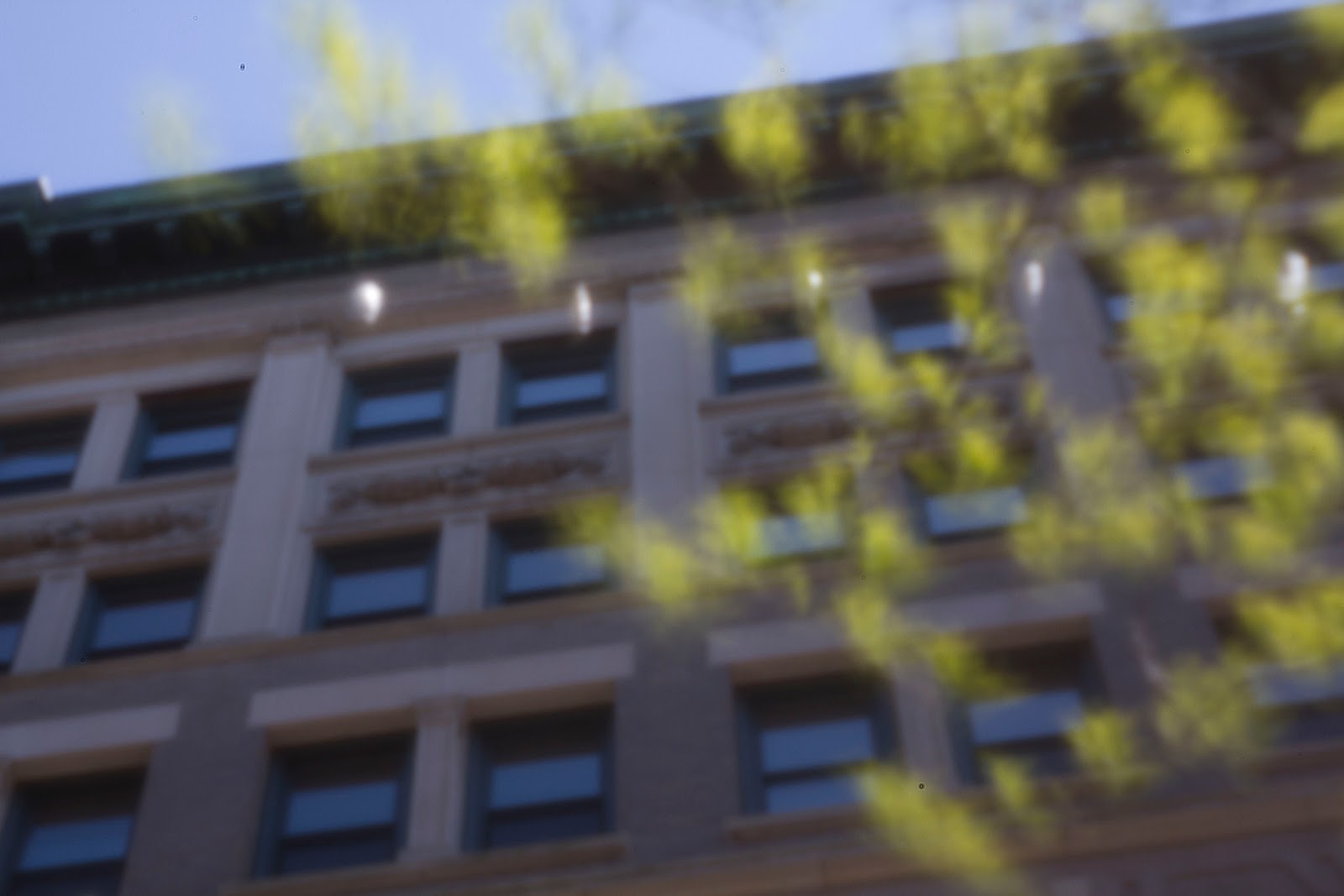
My photo is of a building facade on Westminster Street in downtown Providence, Rhode Island. Because the day was breezy, the leaves in front of the building blew around, creating a blur of green. A string of white lights in front of the building was dancing around too.
It's pretty cool that people all over the world were doing the same thing at the same time. So far, over 59 countries are represented in the project.