Sunday, June 30, 2013

China Air: Smog Mixed with Occasional Fog

Fog Tucked into the Mountain Folds in the Three Gorges Area of the Yangtze River
It always looked like it was going to rain. When it wasn't raining, the sky looked like rain was coming. Except it wasn't.

Smoggy View Across the River from Shanghai's Bund
Tourists Photographing Through the Haze at the Moat of the Forbidden City in Beijing

Tourists at Tien An Men Square Looking through the Haze Across the Square


Cutest Chinese Children

Three What?
Practical Pants Slit


I think Chinese children are so cute.  Maybe it's the shape of their faces? Chinese people refer to Caucasians as "Big Nose People". Not such a cute name.


I loved watching this baby boy on his mother's lap on a train ride. He was tired and squirming, but his mom was extraordinarily patient.

Goldfish Watching With Matching Hat

Baby in a Basket
Doing a Dance for Visitors to School (Maybe it's been done once or twice before?)


Monday, June 24, 2013

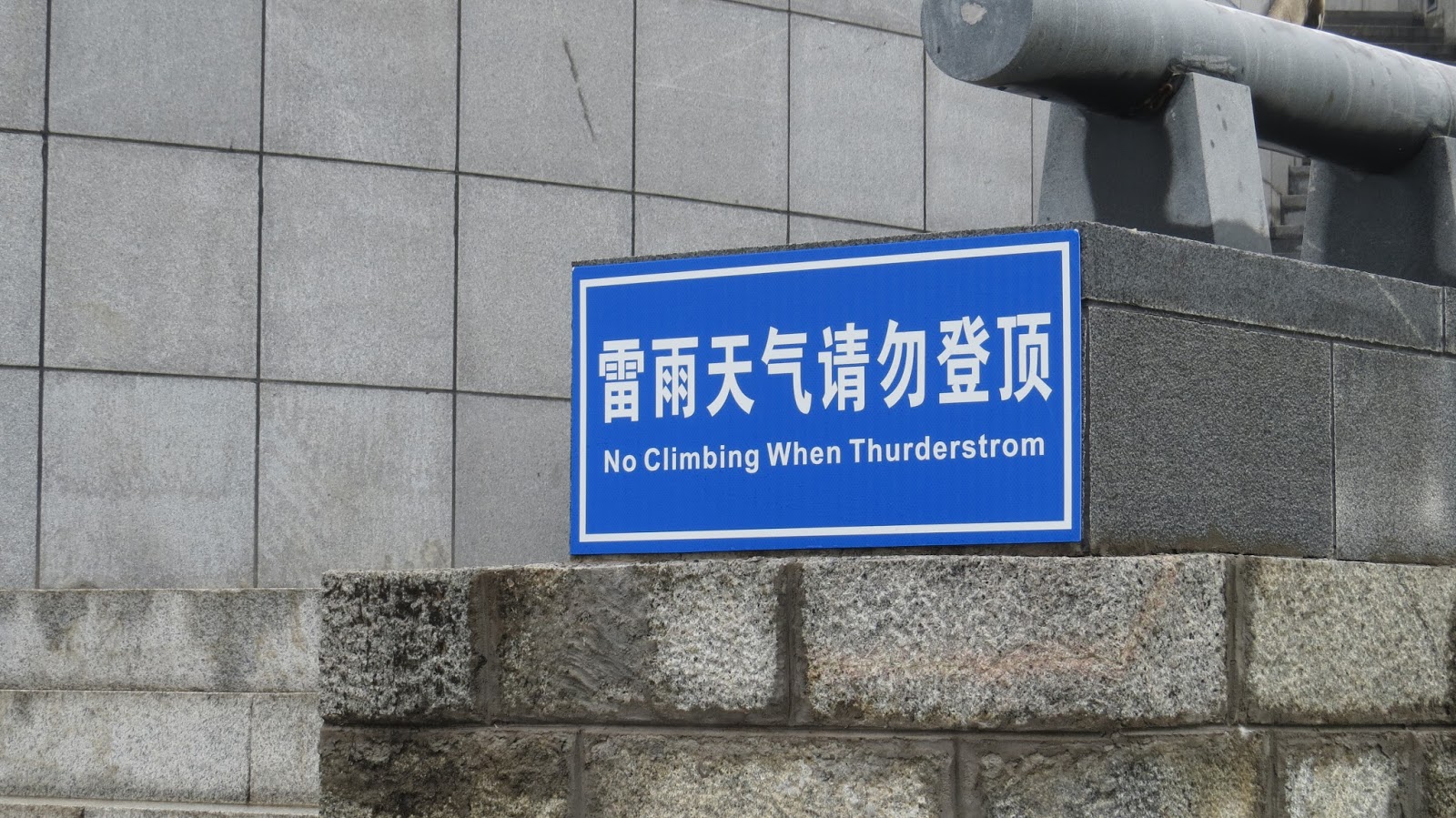
A Chinese Head-Scratcher: Tangled Translations

Why are silly signs posted all over China?

Can't you just say "Entrance" and "Exit"?

Just on one day's outing in Suzhuo, a city of about 4 million people, I encountered multiple mess-ups. The particularly puzzling thing is that I had arrived by a fast new train that is so competently cutting edge. Why is the complicated engineering right and the syntax wrong?

Terrific Technology

You can't step away from the train without tripping over a small error.


Suzhou is known as the Venice of China, with canals, picturesque footbridges, and more than a dozen gardens designated as World Heritage sites. In one garden alone, known as the Humble Administrator's Garden, sign after sign was tortured text. Here is one example.


A sign at the visitors' center of the Yangtze River Dam.  


Securing Tien An Men Square

I was on Tien An Men Square on June 5. That day was the 24th anniversary of the Student Uprisings on the square. It being my first time to the square, I did not know whether security was stepped up or not.


The entrance to Chairman Mao's Tomb was blocked off.

There were security cameras everywhere (but it appeared to me that they were permanent fixtures).

Really, only ONE Warrior Survived: Crushed Terra Cotta


The Only Terra Cotta Warrior that Was Found Intact - All the Rest were Broken
I had a surprise when I visited the Terra Cotta Army in Xi'an, China. Only one clay soldier was found intact. When you see the sea of soldiers, what you see is thousands of figures that have been pieced together from broken pieces. Before touring the tomb, I had seen many photos and written accounts about the thousands of life size clay figures dating from the third century BC, buried to protect China's first emperor as he crossed into his afterlife.  The collection of 8,000 clay soldiers, 130 chariots and 670 horses was discovered in 1974, along with the tomb of the first emperor of China, Qin Shi Huang.  
Terra Cotta Soldiers buried in the tomb of China's First Emperor; Some are Headless

What was news to me was that in the throng of thousands of sculptured figures standing on display in the enormous pits, only one soldier was found intact. Except for  him, every one of the other nearly 9,000 items has been pieced together and restored. It is like a giant, maddening puzzle. The amount of restoration work boggled my mind.  
Details of Broken Soldiers Put Back Together Again
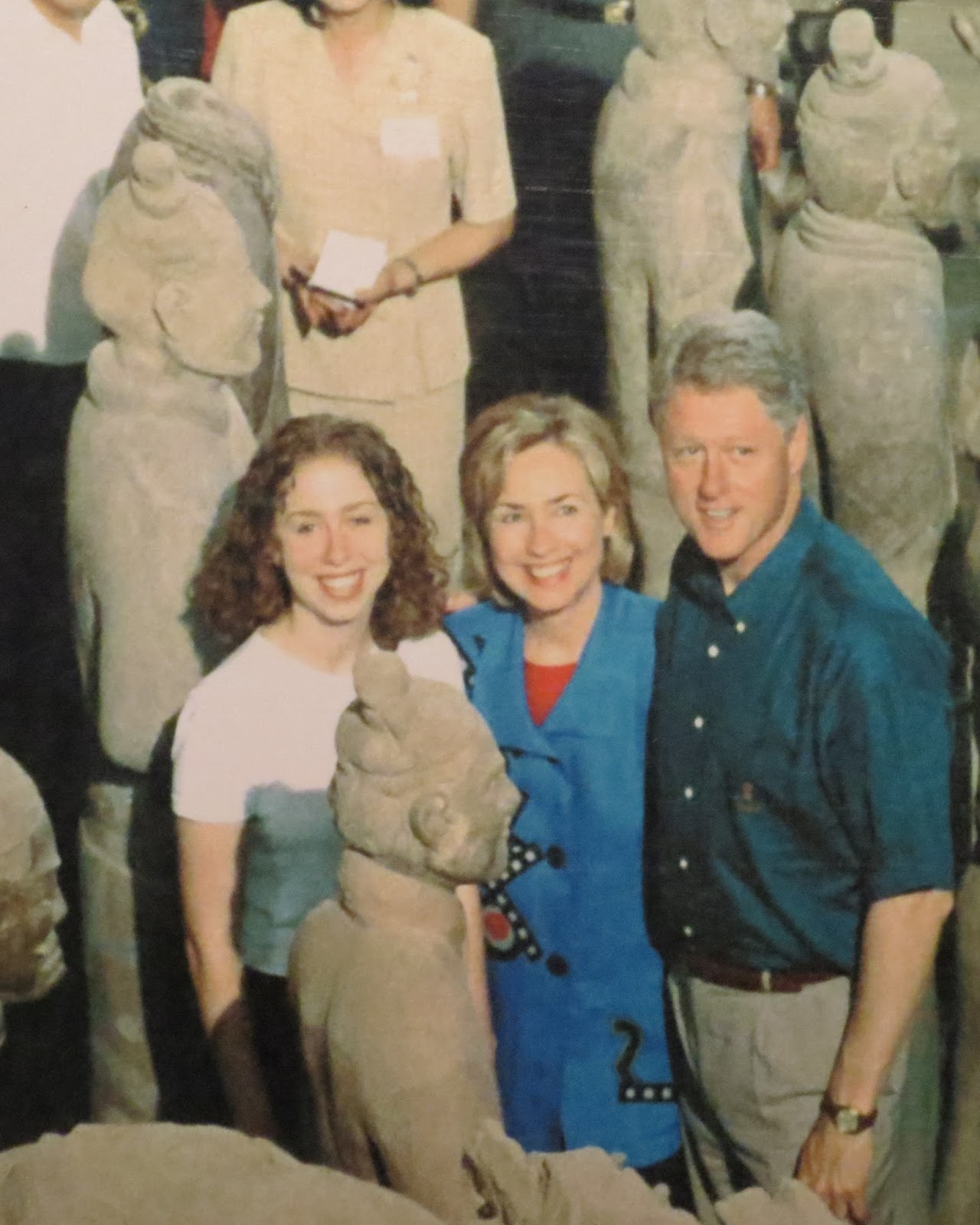
The Farmer who Discovered the Tomb, while searching for Water (see his poster above), posing with Random Tourists

Other Random Tourists Visiting the Tomb

Warrior Restorers


China's One Car Policy

There are so many people, so many cars, so much smog and so much noise in China, that the government has stepped in to impose some controls.

In Beijing, people are generally allowed to own only one car. There are 6 million cars in Beijing. To own a second car, a resident of Beijing must get on a waiting list - and wait and wait and wait. The car dealer can strike a deal with a buyer, but the customer's permission must come through before the sale can close. 
In Shanghai, the cost of a car registration is the limiting factor. It costs about $10,000. A license can be had for a little less if the license has the number 4 in it. The Chinese word for the number four sounds like the word for death which sounds like "suh". 
Yes suh, I'll take a discount.


Mrs. Wong and her Orange-Eared Dog


The Hutongs in Beijing are the crowded streets of old buildings, where several families cram into small spaces lacking indoor plumbing; many without electricity. Mrs. Wong is an elderly woman who makes arrangements with the government to invite tourists into her home.  She resides in one of the nicer Hutong homes.  She lives alone in a parlor that can accommodate 14 or so guests crowded around, plus a sleeping alcove cordoned off by a curtain, and a kitchen. She has running water, electricity and heat. She lacks a toilet or bathing facility. Mrs. Wong counts herself lucky because the neighborhood's public toilet and shower facility serving her sector is steps away from her front door. 
Mrs. Wong's Hutong, Beijing
She and her 30-something niece invite visitors into Mrs. Wong's home to see what life is like in the Hutongs, and to see her niece's demonstration of the intricate process of bottle-painting. The art flourished during the emperors' reigns, when royalty carried their snuff in beautifully decorated glass bottles. The bottles are painted from the inside, requiring wisps of fine bristles, a steady hand and eagle-sharp eyesight.  Mrs.Wong taught the skills to her niece, having painted for many years until her eyes failed, and having learned the art from her grandfather who painted for the royal family in his prime. As a talented servant to the royals, Mrs. Wong's grandfather enjoyed the perqs of aristocracy. He owned a grand home in the typical rectangular design, with many rooms facing into an inner courtyard. The People's Revolution seized his grand residence, leaving him with a sliver of one corner. He passed his home down to his granddaughter, Mrs. Wong; and he taught her the art of snuff bottle painting. She feels lucky to have the home she has - and to have it to herself. During the course of the visit, Mrs. Wong spoke through an interpreter, explaining how highly regarded her grandfather's work was. She showed one snuff bottle he had painted; and then photos of acclaim for her niece's bottles which are for sale at the end of the visit. 
Sample of Snuff Bottle Painted by Mrs. Wong's Grandfather for the Last Emperor
Mrs. Wong derives just about the same amount of joy from her white poodle pet.  The dog's ears were dyed bright orange. She explained that the festive color was in honor of its birthday. But, apparently, Mrs. Wong did not need a birthday excuse to decorate the dog. A photo of the dog sporting ears of lemon yellow blinked as the screensaver on a personal computer  in the sleeping alcove. The distraction of dog dying might help keep Mrs. Wong from mourning that life is but a sliver of what her grandfather had before the Cultural Revolution. 
Mrs Wong's niece, showing photo of herself being honored for her skills in the ancient art of painting snuff bottles from the inside; and Mrs. Wong's poodle pic on the screensaver, sporting yellow ears